
In most Kuwaiti homes, water reaches the taps through a pump, either a transfer pump that lifts water from the ground tank to the roof tank, or a booster pump that raises water pressure across the floors. When the pump stops, especially in summer, the whole house is left without water. Plumber Kuwait repairs all types of water pumps across Kuwait, and we find the cause of the fault before replacing any part, so you never pay for parts you do not need.
Types of pumps we repair
- Booster pumps: raise water pressure at taps and showers and switch on automatically when a tap is opened.
- Transfer pumps: move water from the ground tank to the roof tank, usually controlled by an electric float switch.
- Submersible basement pumps: pump out water that collects in the basement pit and lift it to the drainage network.
- Hot water circulation pumps: in villas with a central heater, they bring hot water quickly to distant bathrooms.
The most common pump faults
The pump runs but no water comes out
The most common cause is air entering the suction line, an empty ground tank, or a faulty non-return valve that lets water drain back to the tank so the pump loses its prime. The cause can also be a worn or blocked impeller inside the pump.
The pump keeps switching on and off
If the pump runs for a few seconds, stops, and repeats this even with all taps closed, there are three likely causes: a leak somewhere in the house, a small pressure tank that has lost its air or has a torn rubber membrane, or a faulty pressure switch. This wears the motor out quickly and should be fixed early. If the cause is a hidden leak, our water leak detection service can find it.
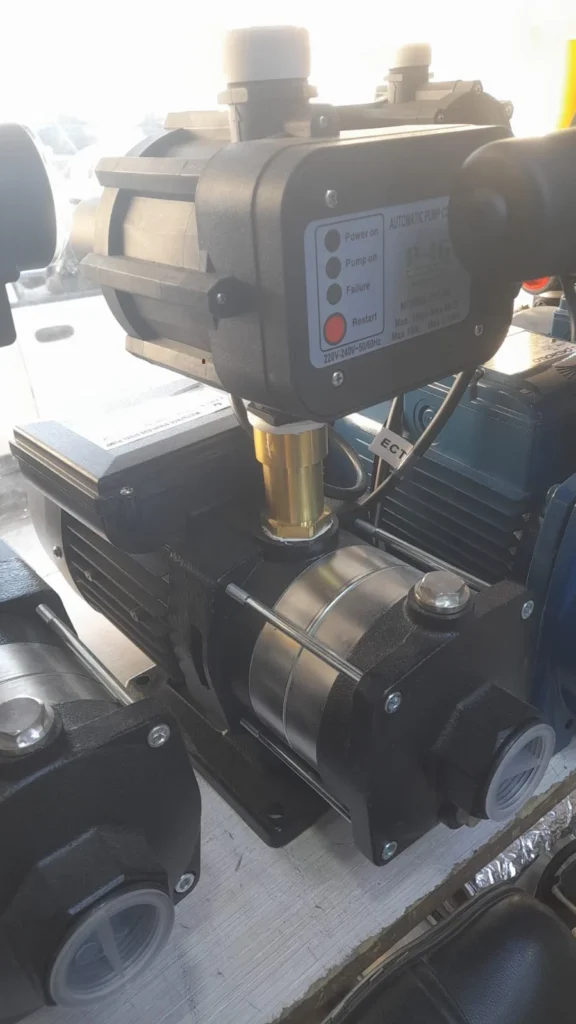
The pump does not work at all
We start with the electrics: the breaker, the wiring and the pressure switch. If the pump hums without turning, the cause is usually the capacitor, a relatively inexpensive part. Some pumps also have dry-run protection that stops them when the tank is empty. If the motor has burnt out, we compare rewinding it with replacing the pump.
Loud noise or vibration
A metallic or whining noise usually means worn bearings. A sound like gravel inside the pump happens when the pump draws less water than it needs because of a blockage or a narrow suction line, and this eats away the impeller over time. Strong vibration can come from a loose mounting or a pump that is not level.
Water leaking from the pump body
A leak between the motor and the pump body usually means the mechanical seal has failed. Replacing it early matters, because leaking water reaches the bearings and the motor and damages them.
The motor overheats and trips
Pumps installed in enclosed spaces or in direct sun heat up quickly in Kuwait’s summer, and the motor may cut out because of the heat. Constant cycling caused by a leak or a faulty pressure tank also raises the motor temperature. We fix the underlying cause instead of simply restarting the pump.
Low pressure even though the pump is running
The pump may be too small for the house, the impeller may be worn, the filter on the suction line may be blocked, or the pressure switch may be set too low. We measure the pressure and check the line to see whether the answer is an adjustment, a repair or a pump of a more suitable size.
The danger of running a pump dry
Water cools the pump and lubricates the mechanical seal. Running it empty, even for a few minutes, can destroy the seal and the impeller. If the ground tank runs dry, switch the pump off straight away and do not restart it until the tank has refilled and the pump has been primed. We recommend fitting dry-run protection if your pump does not have it.
Signs your pump needs checking soon
Before a pump stops completely, there are usually early signs that are easier and cheaper to fix in time:
- The pump takes longer than usual to fill the roof tank.
- Water pressure rises and falls noticeably while you shower.
- The motor sounds different or louder.
- Drips or rust marks under the pump.
- The motor body is very hot to the touch after running briefly.
- Your electricity bill goes up because the pump is running for longer.
How we diagnose a pump fault
- We ask what the fault looks like, when it started and whether the tank ran dry recently.
- We check the electrics, the capacitor and the pressure switch.
- We check the suction line, the non-return valve and the filter.
- We measure the pressure in the pressure tank and check its membrane.
- We listen to the motor and check the bearings and the seal.
- We explain the cause, the part needed and the price before starting.
Spare parts we replace
- Capacitor: a common reason for a motor that will not turn.
- Mechanical seal: stops water leaking from the pump into the motor.
- Bearings: worn bearings cause loud noise and overheating.
- Pressure switch or electronic controller: controls when the pump starts and stops.
- Pressure tank or its membrane: prevents constant switching on and off.
- Non-return valve: keeps water in the suction line.
- Electric float switch: starts and stops the transfer pump according to the water level in the tank.
Repair or replace the pump?
Repair is the right choice when the fault is in the capacitor, seal, pressure switch or pressure tank and the motor is sound. Replacement is better when the motor of a small household pump has burnt out, the pump body is corroded, or the pump was too small for the house in the first place. In that case we help you choose the right size as part of our pump installation service.
What to do when the pump cuts your water supply
- First check that there is water in the ground tank, as an empty tank is the most common cause of no water.
- Check the pump’s breaker in the distribution board, and if it trips again do not reset it.
- If the pump runs but delivers no water, switch it off so the seal is not damaged by running dry.
- Some homes have a bypass valve that lets water flow from the roof tank by gravity without the pump, which can be used until the technician arrives.
- Take a photo of the pump and its label and send it to us on WhatsApp, so we bring the right part on the first visit.
Pumps in flats and apartment buildings
In apartment buildings, one or two pumps supply many flats, and any fault cuts water to everyone. We advise building owners to have a standby pump installed in advance that takes over when the main pump stops, and to have pumps and tanks checked regularly. We work with the owner or the building watchman to restore water as quickly as possible, then fix the underlying cause so the fault does not return.
Correct installation means fewer faults
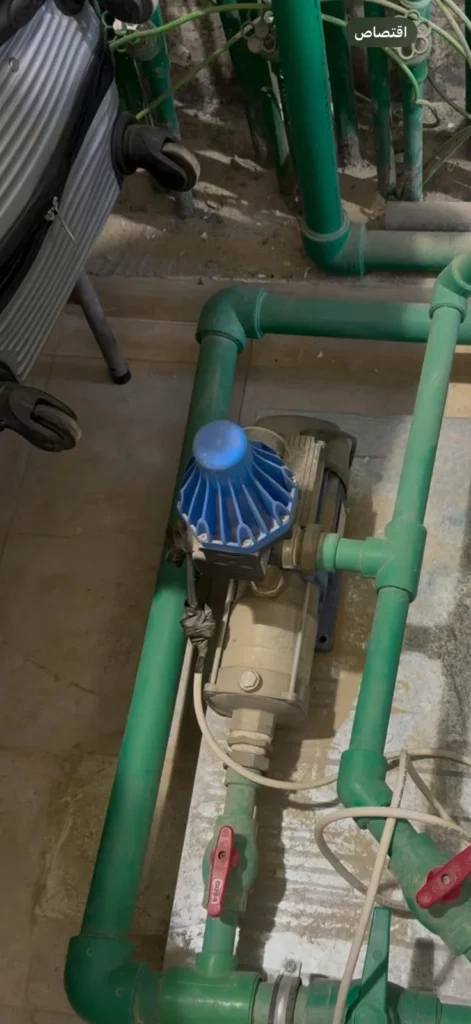
Many repeated pump faults are caused by the way the pump was installed rather than by the pump itself. A pump should sit close to the tank with a short suction line of the right diameter, be fixed on a level base, have a valve before and after it for easy maintenance, and have a pressure gauge that shows how it is working. If your pump was installed badly, we may recommend a small change to the installation that saves you many faults later.
Pumps in Kuwait’s summer
In summer, water use rises and pumps run for longer in extreme heat, which is why most faults appear in this season. Placing the pump in a shaded, well-ventilated spot and having it checked before summer greatly reduces the chance of it stopping on the hottest days. If the basement pump fails during rain or because of a leak, we also offer basement pit pumping.
Regular maintenance extends pump life
- Check that the pump stops completely when all taps are closed.
- Check the air pressure in the pressure tank once or twice a year.
- Clean the suction line filter if there is one.
- Watch for drips under the pump or any change in its sound.
- Clean the ground tank regularly so the pump does not draw in sediment.
Cost of pump repair
The cost depends on the type and power of the pump and the part needed. Replacing a capacitor is different from replacing a mechanical seal or rewinding a motor. After the inspection we explain the cause and the price in Kuwaiti dinars before we start, and we tell you honestly if replacement would cost less.
What decides the cost
We do not quote a fixed price before seeing the job. After the inspection the plumber tells you the price in Kuwaiti dinars before starting.
| Factor | What it means |
|---|---|
| Type of work | A simple repair, a new installation or changes to the lines. |
| Parts and materials | Their type and quality, and who supplies them. |
| Size of the job | The number of points, appliances or the length of the line. |
| Access | Behind fixed units, under tiles or in a basement. |
Related guides
- Shower Installation in Kuwait
- Sanitary Ware Installation in Kuwait
- Washing Machine Installation in Kuwait
- Water Leak Detection in Kuwait
- Water Filter Installation in Kuwait
- All plumbing services in Kuwait
Frequently asked questions
Need a plumber now?
Call or WhatsApp +965 66493272. Plumber Kuwait works 24 hours a day in every area of Kuwait.
How do I book a plumber?
Call 66493272 or send a WhatsApp message describing the problem, your area and a photo if you can. We confirm the visit time with you.
How is the price decided?
After the inspection, based on the type of work, the parts needed, the size of the job and how easy the problem is to reach. The plumber tells you the price before starting.
Which areas of Kuwait do you cover?
We work across Kuwait, including Hawally, Salmiya, Jabriya, Salwa, Rumaithiya, Farwaniya, Andalus, Shuwaikh, Yarmouk and Khaldiya.
Can I call at night or on weekends?
Yes, you can call or message 66493272 at any time, 24 hours a day, including weekends.
What should I do before the plumber arrives?
If water is leaking, close the main water valve, switch off any heater or pump on the affected line, and clear the area around the problem.